
What's Really Behind The So-Called "AI Layoffs"?
If you're a leader considering AI layoffs, please read this first


Dear leaders,
Slapping a “because AI” label on your next round of layoffs is a bad idea for at least two reasons:
The market used to love it, but now is more likely to punish you than reward you. The tactic of blaming AI is rapidly backfiring.
The signals you’re sending your peers in other companies are cuckoo bananas and pollute the well for everyone.
I dig into the evidence and explain the logic here.
Turns out that 55% of employers admit to regretting their AI-driven layoffs.[E6] I keep hearing stories of desperate astronomical offers made to (and often rejected by) ex-employees. Gartner projects that by 2027, half of enterprises without a people-centric AI plan will lose top talent.[D3] Good luck fixing trust when you’ve “replaced” the very people you most desperately need. Especially when you discover just how much extra (human) coordination you need when you add complex systems to the mix.
A quick ad break: My course will run on-demand soon, with a 2 hour live Q&A session on Friday Jul 17 at 10 AM - 12 PM Eastern Time. 👇 Scroll to the bottom for a discount code.
You might have a real AI strategy if you are deliberately moving spend away from repetitive human execution and toward AI infrastructure, tooling, workflow redesign, and the systems that make your teams more effective. Some of you really are preparing the site for a different kind of company, and that preparation will not be free. The old budget may have to fund the new build because money does not grow on org charts.
Fine. Clear the ground. Put serious money behind serious plans. But don’t confuse buying AI with doing AI. If your plan is to plug in the tools and wait for miracles, you’re gambling. To turn the gamble into an investment, you need a plan, a measuring stick, and the right people in the building.
How do you know if AI has replaced a whole job? You verify that the system you’ve launched (past tense) has been fully tested to do the entire job, reliably, in production, with the monitoring, guardrails, escalation paths, and humans in the loop worked out. If you’ve managed to build that, you should by all means say it like it is. Your company would be in the tiny minority, though. Most companies are somewhere between sandbox, pilot, and the revenge of the CFO.
The rest might want to rethink their relationship with the word “because.”
It’s not “because you’re doing AI” if what you’re really doing is exuberantly swinging the axe while hoping that AI will be useful to you. Hope is not a strategy.
It’s not “because you’re doing AI” if you’re more obsessed with giving your teams the ability to use tokens than with figuring out what those tokens should be used for. (Last week, Amazon was the most recent egg-on-face victim of the tokenmaxxing craze.[M6]) Those tokens don’t understand the nuances of the work. Your people do.
It’s not “because you’re doing AI” if you’re hunkering down for economic uncertainty and conserving your resources.
It’s not “because you’re doing AI” if you’re churning your labor because this feels like the right time to let your least trusted people go. (And so much of what’s happening is about trust, specifically: whether you can trust your workers with hard-to-verify work. Because verifying human work that remains post-AI will be harder than verifying pre-AI human work.)
It’s not “because you’re doing AI” if your plan is to drop your people so they go retrain themselves while unemployed and to rehire them from an upskilled pool later.
It’s not “because you’re doing AI” if you haven’t figured out your business model or updated your processes because you have no idea what you’re doing and you’re running lean while you get your ducks in a row.
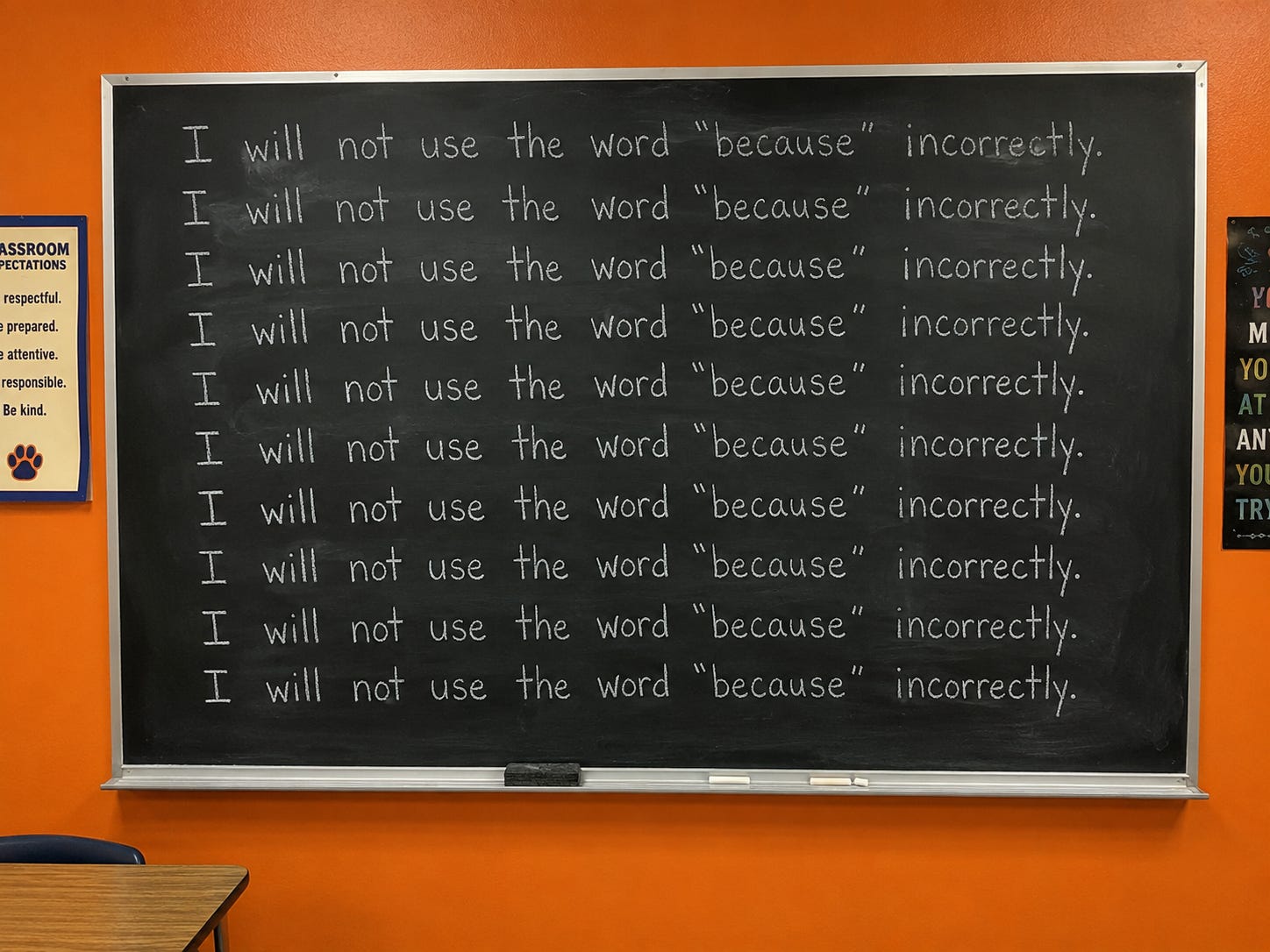
Even if you would rather be dragged over hot coals than admit any one of these things to your board, at least admit them to yourself. Your peers are going to do what they do. But when you ponder their moves, please do bear in mind that many of them are picking from this menu when they put the words “because” and “AI” in the same sentence.
AI is impressive, but not so impressive that it frees you from the obligation to work out a clear vision, redesign your processes, and retrain your teams (teams plural, made up of humans plural, whose attention, good judgment, and domain expertise provide the steering that keeps a complex system from imploding).
Many of you have been relying on people to do the invisible work of handling ambiguities, inconsistencies, clashing incentives, and lack of steering. If you’re planning on leaving them behind, you’d better hope all your problems are uniform and straightforward. That’ll be true for some of you. Relatively few of you.
Frankly, it’s about time the market woke up and started asking whether companies are trimming fat or cutting muscle. You can’t strip the engine out of a car to make it lighter and still expect it to win the race.
Oh, and don’t get me started on the vibe coding dabblers. In the words of one frustrated Head of Product I spoke with last week:
“I don’t think [our CEO] has any idea what these people actually do but still insists we fire 20% of them to ‘make room for AI.’ He vibe coded one app in a weekend and now he’s asking what we do all day. Make it work as a whole system, that’s what. If we put that crap into production [our top customer] would drop us on the spot.”
No wonder the CEO of Box recently diagnosed his fellow CEOs with “AI psychosis.”[U1] According to him, CEOs “uniquely prone to AI psychosis” because they’re too far removed from the “last mile” of actual work where AI’s value has to be produced. They play with AI, make a prototype or generate a contract, then jump to the conclusion that agents can do whole jobs. But they are not the ones reviewing code, finding bugs, catching hallucinated libraries, training models on company-specific contract terms, or doing the detailed verification work before anything can safely go live.
Whether or not AI psychosis is the right term for it, the phenomenon he’s describing is on the rise. Jumping to foolish conclusions is dangerous and too many senior leaders are doing exactly that. I hope we collectively put down the scissors we’re running with. And soon!
🗞️ AI News Roundup!
The monthly news roundup is its own separate article available here. All the sources referenced in this piece are in there.
Sources
The sources are all available here.
Thank you for reading and sharing!
I’d be much obliged if you could share this post with the smartest leader you know.
👋 On-Demand Course: Decision-Making with ChatGPT
The reviews for my Decision-Making with ChatGPT course are in and they’re glowing, so I’ve opened enrollment for another cohort and tweaked the format to fit a busy schedule. You’ll be able to enjoy the core content as on-demand recordings arranged by topic and then you’ll bring your questions and I’ll bring my answers in a live 2 hour-long AMA with me on Friday Jul 17 at 10 AM - 12 PM:
If you know a leader who might love to join, I’d be much obliged if you forward this email along to them. Aspiring leaders, tech enthusiasts, self-improvers, and curious souls are welcome too!
Promo codes
My gift to subscribers of this newsletter (thank you for being part of my community!) is $200 off the list price of my course with the promo code SUBSCRIBERS. If you haven’t subscribed yet, here’s the button for you:
If you’re keen to be a champion of the course (you commit to telling at least 5 people who you think would really get value out of it) then you are welcome to use the code CHAMPIONS instead for a total of $300 off — that’s an extra $100 off in gratitude for helping this course find its way to those who need it. (Honor system!)
Note that you can only use one code per course, the decision is yours.
P.S. Most folks get these courses reimbursed by their companies. The Maven website shows you how and gives you templates you can use.
Forwarded this email? Subscribe here for more:
This is a reader-supported publication. To encourage my writing, consider becoming a paid subscriber.